RWB Executive Chairperson Inspects VCRP Progress in Nyabihu and Rubavu Districts
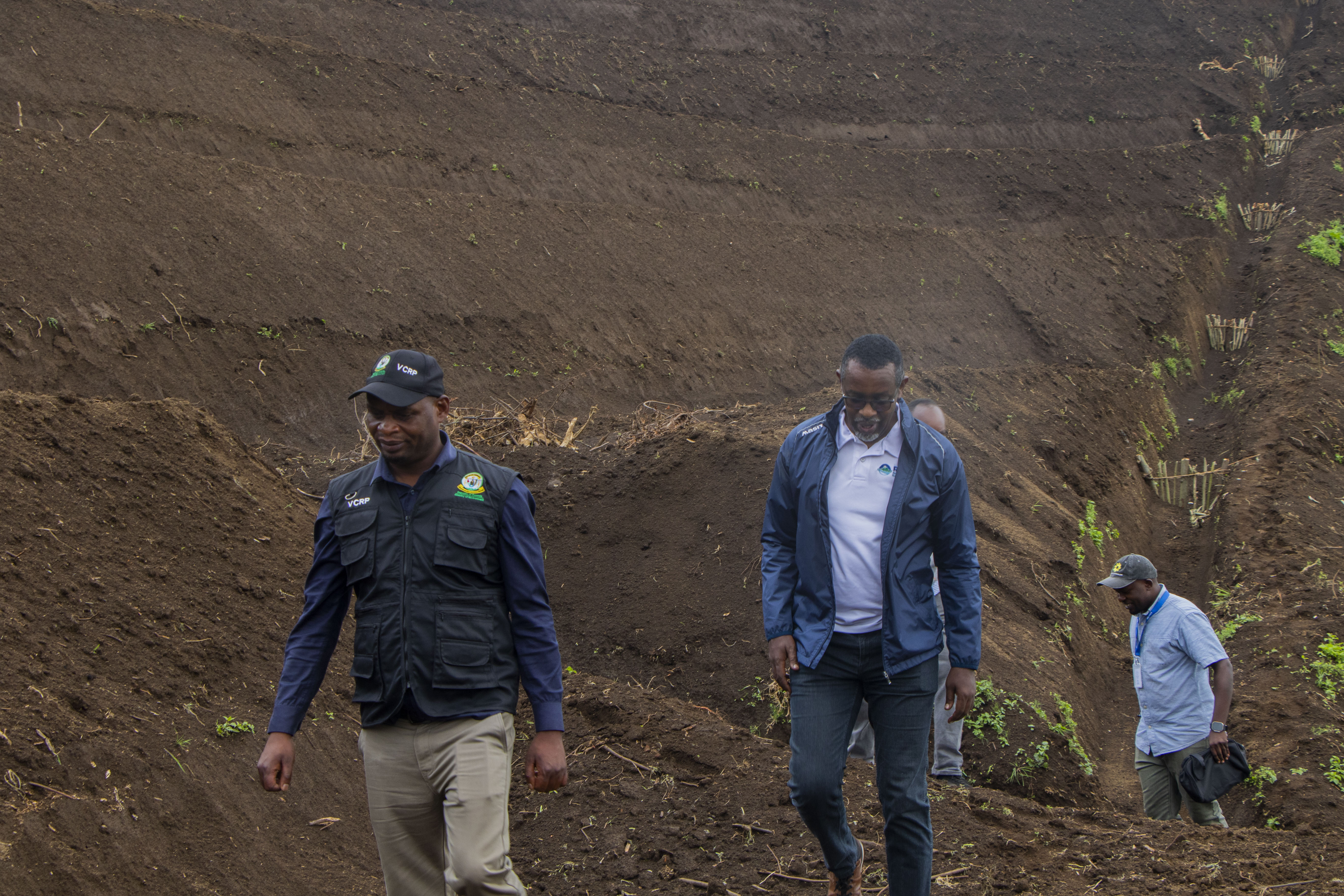
The Executive Chairperson of the Rwanda Water Resources Board (RWB), Richard Nyirishema, conducted a three-day field visit to inspect the ongoing implementation of the Volcanoes Community Resilience Project (VCRP) in Nyabihu and Rubavu Districts.
During his visit, the EC held strategic discussions with District Vice Mayors in charge of Economic Development to ensure that project activities remain aligned with the primary needs of the community.
"The collaboration between the Districts and RWB is the foundation of the project's achievements so far," stated Executive Chairperson Eng. Richard Nyirishema. He emphasized that RWB remains committed to a decentralized approach, noting that local leadership is best positioned to understand the specific land management challenges faced by citizens. "We are working closely with the districts to ensure that every investment directly translates into safety and prosperity for the people living here."
In Nyabihu District, the impact of these interventions is already visible at Lake Karago. Jean Claude Habanabakize, the Vice Mayor in charge of Economic Development, highlighted how erosion and flood control measures have physically transformed the landscape. He noted that the lake, which previously suffered from heavy sedimentation and a muddy appearance due to eroded soil, has seen a remarkable transition, with the water now appearing significantly clearer.
He further explained that the project’s scope extends far beyond the environment. "While the ecological focus is critical, the VCRP is empowering our citizens to 'graduate' from lower socio-economic categories to higher ones. Our residents are now earning enough to contribute to the 'Ejo Heza' long-term savings scheme, which not only secures their future but also improves our district’s national performance rankings."
The VCRP aims to enhance climate resilience, mitigate flood risks, strengthen watershed management, and improve the livelihoods of communities within the targeted region. Key investments focus on flood risk reduction, ecological and catchment restoration, and sustainable livelihood development.
To date, the VCRP has reached significant milestones in its mission to build a resilient landscape. These include the completion of village-based land use action planning in 60 villages and the establishment of 217 hectares of radical terraces alongside 189 hectares of progressive terraces. Additionally, the project has created 332 hectares of erosion-control trenches and integrated agroforestry across 1,184 hectares. On the household level, 357 water harvesting tanks and 167 cows have been distributed to vulnerable families, providing a sustainable foundation for both food security and climate adaptation.