RWB AWARDS YOUNG INNOVATORS AT THE 3RD WATER RESOURCES MODELING HACKATHON
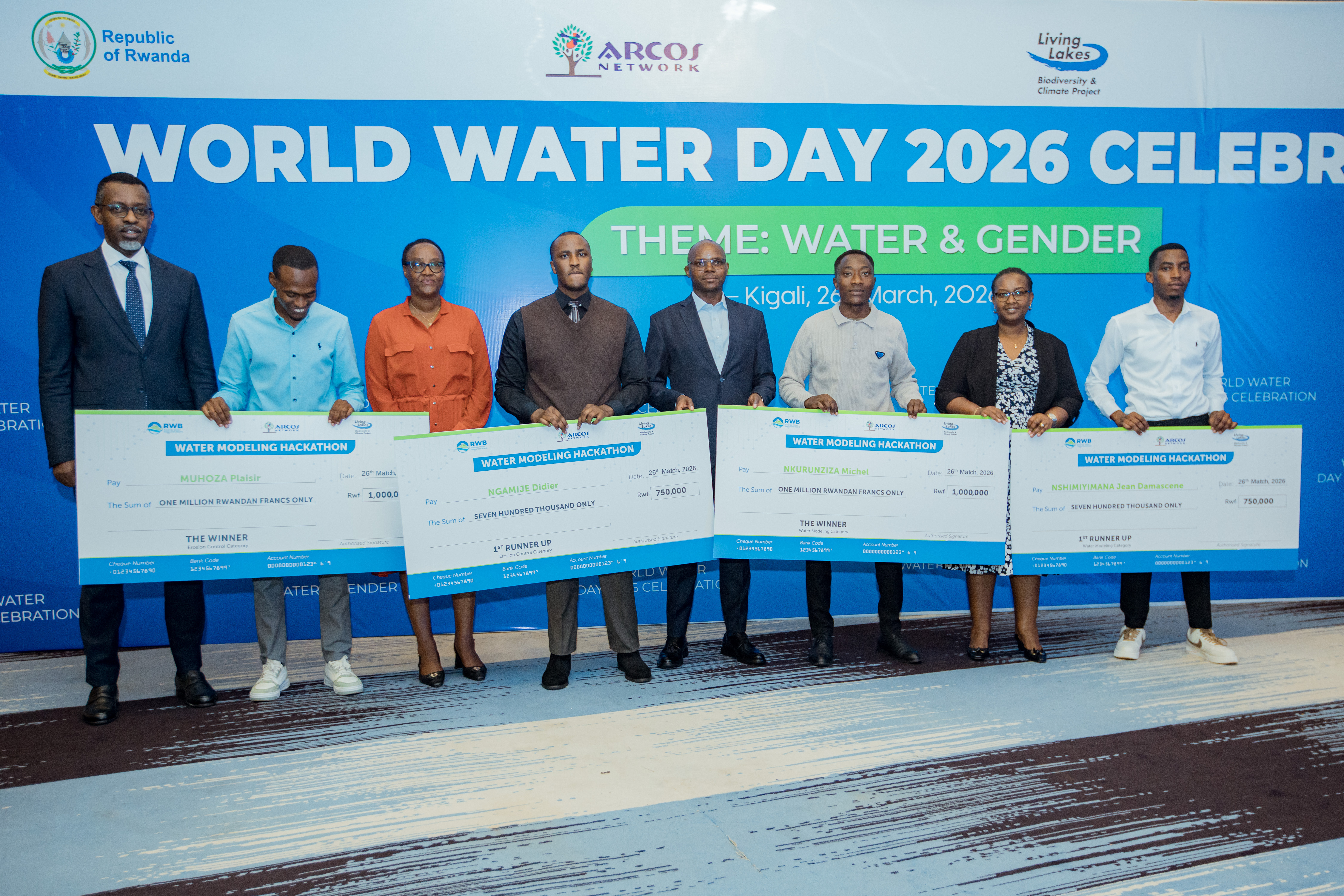
March 26, 2026 – As part of the World Water Day 2026 celebrations, the Rwanda Water Resources Board (RWB), in collaboration with the ARCOS Network, officially awarded the winners of the 3rd Water Resources Modeling Hackathon.
This initiative empowers young professionals to apply advanced science and technology to solve Rwanda’s most pressing water resources challenges.
The 2026 edition focused on two critical technical categories: Water Modeling and Erosion Control. Participants in the modeling category were tasked with the hydrological modeling of the Nyagisozi sub-catchment to assess downstream flood hazards using industry-standard tools like HEC-HMS and HEC-RAS. Meanwhile, the erosion control category challenged innovators to extract radical terraces from satellite imagery using R or Python programming.
Eng. Richard Nyirishema, the Executive Chairperson of RWB, commended the energy of the participants during the ceremony:
“This initiative allows young professionals to apply science and technology to our most pressing water challenges. While we celebrate their innovation today, I also challenge an increased participation of women in the coming year’s cohort to reflect our full commitment to equality.”
The competition saw remarkable talent from the University across Rwanda, with top performers receiving 1,000,000 RWF and runners-up receiving 750,000 RWF to further their projects.
Erosion Control Category: Muhoza Plaisir emerged as the winner for his AI-powered model, "Terax," which automates the extraction of terraces from orthophoto images. Ngamije Didier followed as the first runner-up.
Water Modeling Category: Nkurunziza Michel took the top position for his work on flood prediction and land-use planning in the Nyagisozi catchment. Nshimiyimana Jean Damascene was awarded as the first runner-up.
For the winners, these awards represent more than just professional recognition; they are a vital resource for further technical development. Muhoza Plaisir, who developed an AI-powered model called "Terax" to automate terrace mapping, emphasized the efficiency of his innovation:
"Usually, mapping terraces could take a long time, but our model is capable of extracting them in a very short time. The money I have won will be used to improve the accuracy of my model so that it can be truly useful to society."
Nkurunziza Michel, the top performer in the Water Modeling category, highlighted how his hydrological research translates into real-world safety and infrastructure:
"This model will solve problems by predicting land use and assisting in flood control. We can use this data to design critical structures like bridges and spillways that generate electricity and prevent erosion. I encourage my colleagues to learn these softwares, because the world today deals with digital tools to bring future solutions."
The 3rd edition of the Water Resources Hackathon saw significant engagement from the academic community, where 199 students participated in the Water Resources category and 89 students competed in Erosion Control. Out of these participants, 15 finalists reached the final stage.
The 3rd edition of the Water Resources Hackathon drew significant interest from the academic community, with 199 applicants for the Water Resources category and 89 for Erosion Control, and 15 reached the final.